
What is Kava?
blah
How archaic UK and EU laws are punishing Pacific Island Communities
As documented in hundreds of recent academic papers, regional, national strategies and community vlogs, kava has “played an immensely important cultural and economic role in the lives of Pacific Islanders for thousands of years”. For example kava is now “the largest cash crop in Vanuatu in 2022 (1.5 billion GBP) , eclipsing the sum of all other major crops, including coconut, cocoa, coffee, vanilla, Tahitian Lime, pepper and noni.(…) A farmer household survey conducted by PHAMA Plus in 2023 found that kava cultivation contributed to 82% of household income in communities surveyed in Fiji, 86% in Vanuatu and 73% in Tonga”.
Misinformation on kava circulating online has been significantly damaging to Pacific Islands and kava drinkers alike. This misinformation is primarily due to:
1) Confusion between kavalactone extracts and kava powder (similarly, caffeine extracts are not coffee)
2) Poor quality kavalactone extracts in dietary supplements in Germany in 2002 and related faulty studies, which, by ricochet, affected kava powder with dramatic consequences for the South Pacific economies
Kava powder, as a relaxing drink, is no more than a mild ‘coffee opposite’. Of course, as with coffee, it is possible to enjoy a couple of Machu Picchu americanos, one Columbian expresso, though unwise to drink five Italian expressos in a row.
REM concept: Kava Trade and Governance Initiative
Create an enabling environment using checks and balances for lasting solutions because focusing on shared goals builds trust in systems, improves transparency, and benefits all the Kava trade stakeholders


Gap
Regional Kava initiatives* currently focus heavily on production quality and market access
Lack of credible, robust, coordinated regulatory and governance framework supporting the Intl Kava trade for US/EU markets. Risk of no compliance.
Weak national regulations, governance and enforcement resulting in trade revenue/compliance risks and non efficient use of financial resources and technical assistance provided to government
Limited focus on traceability and certification systems across the supply chain
Adapted from a tested successful partnership model*, the project will develop a credible, solid and reliable legal and governance framework for the Kava trade aligned with global trade standards (e.g. EUDR prep)
Strengthen governance and enforcement with multi-stakeholder collaboration
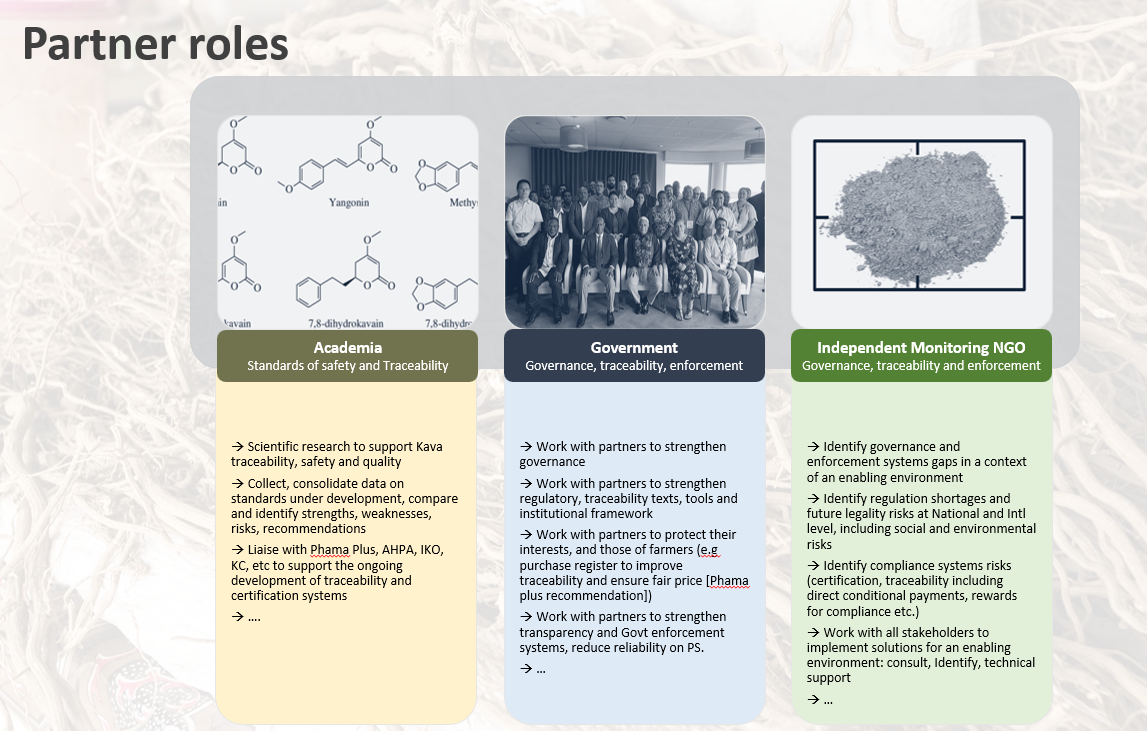
Independent Monitoring implemented with neutrality and objectivity has been proven to help connect key actors with diverging interests, building transparency and trust in systems. An NGO, being the only stakeholder without financial interest in the Kava trade, helps giving credibility to systems involving Governments and Private sector**.
Implement traceability and certification systems, ensuring product safety and quality for international markets
Put in place checks and balances via a constructive approach for long-term positive solutions benefiting all
See Potential benefits slide
Unify regional efforts, aligning standards across Pacific nations
* https://rem.org.uk/monitoring/
** “Paramount to the successful implementation of any strategy is that of ownership – as proven in the past a ‘working group’ finds great difficulty in leading and directing as it cannot be accountable for any decision it takes simply because each member of the group have their individual
functional priorities which often takes precedence over the group priorities. The strategies articulated here will join the other ‘papers’
if no ‘champion’ is appointed, and funded to drive the vision.” Vanuatu Kava Strategy 2016-2025, page 6
Expected impact
Regional Kava Strategy risks addressed
Greater market credibility and access
Equitable and transparent revenue/profit distribution
Improved regulatory compliance
Enhanced resource sustainability